

Bots For Passive Income With AI In 2026 (Without Blowing Up Your Account)
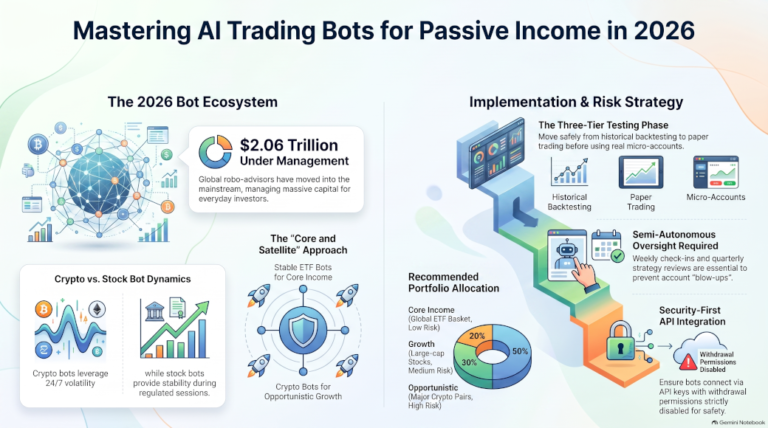
In 2026, robo tools and investment bots are no longer niche, and global robo‑advisors already manage around US$2.06 trillion in assets, so more everyday investors are asking how to buy the right bots for real passive income with AI instead of gambling on hype.
In this guide, we walk through how to choose, test, and monitor AI investment bots. We name the specific platforms worth putting on your shortlist so they help you make money with AI tools while managing risk like a pro.
Key Takeaways
| Question | Short Answer |
|---|---|
| What is an investment bot for passive income with AI? | An investment bot is automated software that trades assets like crypto, forex, or stocks using predefined rules and AI models to target consistent, semi-passive income. |
| Where should I start when buying my first bot? | Start with education. Our hub on AI investment bots & trading automation explains the main bot types, risks, and setup steps in plain English. |
| Which specific bots are worth considering in 2026? | See our bot-by-bot recommendations below; we compare platforms by risk level, transparency, and ease of setup. |
| Are crypto bots or stock bots better for passive income? | Crypto bots can offer higher volatility and opportunity; stock bots tend to be more stable. Our comparison of crypto vs stock trading bots shows who each is best for. |
| How do I choose the best crypto AI trading bot in 2026? | Define your goal, pick a bot type, then check security, performance data, and risk controls, as covered in Section 6 below. |
| Can I really “set and forget” AI bots? | Bots reduce daily workload but still need oversight see Section 9 for a realistic review schedule by risk level. |
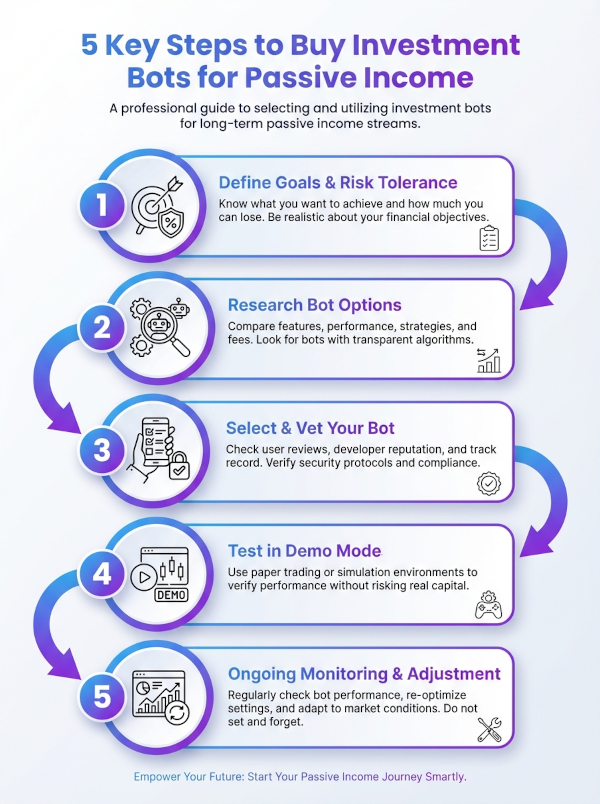
Five essential steps to buy investment bots for generating passive income. A concise visual guide for investors.
1. What Are Investment Bots And How Do They Create Passive Income
Investment bots are software systems that connect to your broker or crypto exchange and execute trades automatically using rules, algorithms, or AI models you configure.
Instead of watching charts all day, you let the bot scan markets, place orders, and manage risk while you focus on your job or business. Most bots aim to turn volatility into incremental gains that stack into steady income over time.
Some use classic strategies like grid trading or trend following; others apply machine learning to predict price patterns or volatility clusters. For many readers, this is also about time leverage.
You use AI tools and automation, so your capital works around the clock, while you only spend a few focused sessions per week reviewing results and adjusting settings.
We view AI bots as similar to AI content creation tools in one key way. You get the best results when you define clear rules, edit the outputs, and keep a risk-first mindset rather than hoping the AI does everything perfectly on its own.
2. Setting Your Goal: The First Step Before You Buy Any Investment Bot
Before you spend a dollar on an AI bot, you need one clear sentence that describes what you want it to do.
Do you want a conservative bot that grows a long‑term portfolio, a higher‑risk bot that tries to make money with AI from intra-day swings, or a diversification tool that runs alongside your index investing?
We guide readers to define goals along four dimensions: capital size, target monthly income, acceptable drawdown, and how often you are willing to review and intervene.
A practical way to start is to write a one‑page bot brief, just like you might write a brief for AI content creation tools. Describe the market, time frame, risk limits, and what “success” looks like after 3, 6, and 12 months.
We stress that passive income goals must be realistic and grounded in data, not social media promises
3. Main Types Of AI Investment Bots You Can Buy In 2026
Different bots suit different income profiles, so understanding the core types helps you avoid buying the wrong tool for your goal.
Crypto Trading Bots
Crypto bots operate on 24/7 markets and lean into volatility. You will see grid bots, DCA (dollar‑cost averaging) bots, arbitrage systems, and trend followers that ride strong moves in either direction. A grid bot may be more passive once tuned, while a high‑frequency scalper needs more oversight.
Stock And ETF Bots
Stock bots work on regulated sessions, from blue‑chip swing trading to sector rotation models that rebalance ETF portfolios. In 2026 many investors use stock bots as a robo‑style layer on top of core index funds, seeking incremental alpha without sacrificing sleep. For passive income, we usually favor slower, swing‑timeframe stock or ETF bots that avoid overnight leverage.
Multi‑Asset And Hybrid Bots
Some platforms combine crypto, stocks, and even forex in one AI system. These bots can diversify your income source but also add complexity, so we encourage extra attention to risk controls and position sizing. You can think of these bots as “portfolio managers with AI assistance.” They might adjust allocations, rebalance weekly, and try to reduce drawdowns in volatile markets while preserving long‑term growth.
Did You Know? 41% of millennials and 40% of Gen Z say they prefer a robo-advisor investing strategy.
4. Crypto vs Stock Bots: Which Should You Buy For Passive Income?
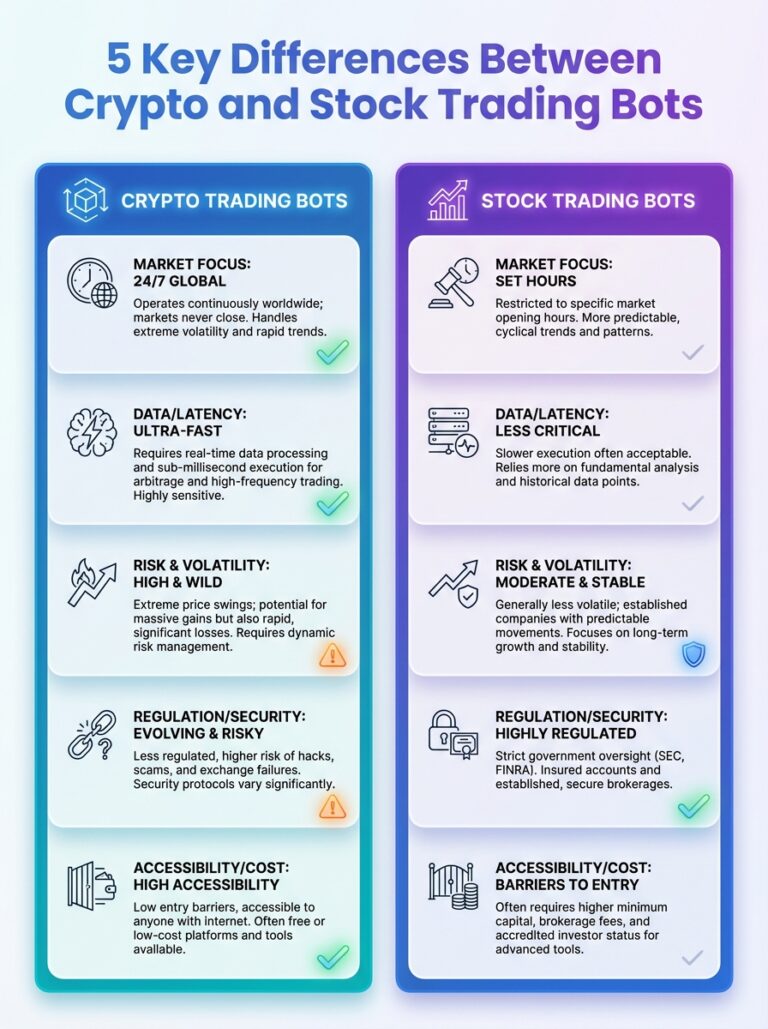
When readers ask us “which is better, crypto or stocks for bot income,” we always answer with “it depends on your tolerance for chaos.”
Crypto offers more frequent trading opportunities and bigger moves; stocks offer more regulation and generally smoother equity curves.
In 2026, many investors run a “core and satellite” approach: a steady stock or ETF bot as the core, and a smaller crypto bot allocation as the satellite to try and boost returns.
For most beginners, we suggest starting with a slower, less leveraged strategy. Once you learn how bot behaviour feels in real time, you can scale into more active systems if they still match your goals
5. Risk Management: The Part Most Investment Bot Buyers Ignore
Passive income with AI only matters if you keep the capital that generates it. That is why we build every guide around position sizing, drawdown limits, and realistic expectations instead of chasing screenshots.
A basic set of rules includes: maximum percent of your net worth in bots, maximum loss per bot, and clear conditions where you pause or stop a strategy.
We also encourage “capital tiers”: use small experimental accounts for high‑risk bots, then reserve your main capital for strategies with long, audited track records and simple logic you actually understand.
Think of risk management as the editing layer in AI content creation tools. The raw output may be impressive, but your review and constraints keep it usable and safe.
6. How To Evaluate An Investment Bot Before You Buy

Once you narrow your options, evaluation is where many investors either protect their capital or walk into trouble. We recommend a checklist that looks at performance, transparency, risk, and integration.
Performance & Data
Look for multi‑year backtests and at least several months of live performance, ideally across different market conditions. Focus on metrics like maximum drawdown, win rate, average trade size, and profit factor rather than headline returns.
Transparency & Control
We prefer bots where you can see the underlying logic or at least the rules framework, even if a machine learning layer optimises parameters. Opaque “black box” bots that cannot explain behaviour are hard to manage when conditions change.
Security & Integrations
Make sure the bot connects using API keys with withdrawal permissions off. Read the provider’s security documentation and privacy policy before connecting anything.
Finally, test the user interface. If the dashboard is confusing or the risk controls are buried, your day‑to‑day oversight will suffer and so will your results.
7. Investment Bots We Recommend For Passive Income In 2026
This is the part readers ask us for most: which bots actually pass our own checklist above? Below are platforms we’ve evaluated against the performance, transparency, and security criteria from Section 6.
As always, run your own due diligence before funding any live account. Start with paper trading or a micro‑account, exactly as we cover in Section 8.
Coinrule: Best For Rule-Based Crypto Automation
Coinrule lets you build crypto trading strategies from plain-language “if this, then that” rules rather than code. This suits readers who want transparency over their bot’s logic, a direct match for our Section 6 criteria.
It connects to multiple exchanges and supports both simple DCA-style setups and more advanced multi-condition strategies.
Best for: Beginners who want to see and control exactly what the bot is doing.
3Commas: Best For Technical, Hands-On Traders
3Commas is one of the longer-standing names in crypto bot automation, with a wide range of bot types (grid, DCA, options) and deep configuration control.
It rewards users who are willing to learn the mechanics rather than accept default settings. So it fits the “review the logic, don’t trust the black box” philosophy we push throughout this guide.
Best for: Readers comfortable tuning parameters and reading backtest data closely.
Cryptohopper: Best For Guided, Education-First Setup
Cryptohopper leans into templates, a strategy marketplace, and educational content, making it a reasonable entry point for readers moving from paper trading into a small live account.
As with any marketplace-style bot platform, treat third-party strategy templates the way you’d treat any unverified backtest; check the live track record before allocating real capital.
Best for: Readers who want structure and guidance rather than building strategies from scratch.
Pionex: Best For Exchange-Native Simplicity
Pionex bundles bot functionality directly into an exchange interface, which lowers setup friction for readers who are already comfortable trading crypto and want built-in bots rather than a separate connected app.
This convenience is worth weighing against the transparency point in Section 6 confirm you can still see and adjust the underlying strategy logic.
Best for: Existing crypto traders who want bots without adding another platform login.
8. Backtesting, Paper Trading, And "Test Accounts" For Safer
Bot Buying
We never recommend going straight from “buy” to “full capital live.” The sensible path in 2026 is still backtest, paper trade, then start live with small capital.
Backtesting
Backtests simulate how a strategy would have performed on historical data. They are useful for identifying obvious flaws, like strategies that only work in bull markets or that rely on unrealistic order execution.
Key points to check include sample size, out‑of‑sample testing, and whether transaction costs and slippage are included.
Paper Trading And Micro‑Accounts
Paper trading lets you run the bot in real time without real money, which helps you understand how often it trades and how it behaves in choppy markets.
Once that looks reasonable, you can use a micro‑account, a very small funded account, to see how it handles real execution and fees.
Every platform in Section 7 above supports this kind of low-risk testing; use it before committing meaningful capital.
Did You Know? 28% of all Americans use robo-advisor investing, showing how mainstream automated investing tools have become.
9. How "Hands Off" Can You Really Be With AI Investment Bots?
One of the biggest myths in 2026 is that investment bots offer 100% set‑and‑forget income. In reality, the most successful users treat bots as semi‑autonomous assistants that still need supervision.
From our work with readers, a healthy routine looks like this: weekly check‑ins to review performance and logs, monthly reviews to adjust risk parameters, and quarterly reviews to decide whether to keep, pause, or replace a strategy.
Aggressive crypto bots might justify daily attention, while conservative ETF bots might only need light weekly checks.
If you want to make money with AI tools without adding another full‑time job, you structure your bot portfolio with these time budgets in mind and avoid any system that demands more attention than you realistically have.
10. Building A Simple Bot Portfolio For Diversified Passive Income
Instead of betting everything on a single “holy grail” bot, we prefer diversified bot portfolios that spread risk. This approach mirrors how long‑term investors spread capital across sectors and asset classes. A simple 3‑bot portfolio for 2026 could look like this:
| Bot Role | Asset | Risk Level | Capital Allocation | Oversight Frequency | Platform To Consider |
|---|---|---|---|---|---|
| Core Income | Global ETF basket | Low | 50% | Weekly | Robo-advisor / stock bot confirm current provider terms |
| Growth | Large‑cap stocks | Medium | 30% | Weekly | Stock swing-bot platform of choice |
| Opportunistic | Major crypto pairs | High | 20% | Daily quick review | Coinrule, 3Commas, Cryptohopper, or Pionex (see Section 7) |
You can then adjust each slice as you see how comfortable you are with swings and how consistent the income feels.
11. Avoiding Scams And Unrealistic Promises When Buying Bots
The rise of AI tools and passive income marketing has also attracted bad actors. We spend a lot of time testing and filtering platforms so you can avoid common traps. Here are signals that usually make us walk away:
- Guaranteed returns or “no loss” claims
- No verifiable performance data or only screenshots
- Withdrawal permissions required on your API keys
- Pressure tactics, such as limited‑time “secrets” or upsells
We also look at the people behind the product. Do they share their real identities, experience, and clear documentation, or do they hide behind anonymous profiles and vague stories?
If something feels off, trust that instinct and either test with a tiny amount or skip it entirely.
There are enough reputable AI investment tools in 2026 that you never need to accept poor transparency just to participate.
This is also the bar we hold the bots in Section 7 to; if any of them stop meeting it, we’ll update this guide.
Conclusion
Buying investment bots for passive income in 2026 can be a smart way to make money with AI, as long as you treat them as tools, not magic.
You define clear goals, choose the right asset class and bot type, test carefully, and manage risk so that income stays consistent over years, not just weeks.
If you want a structured path, start with the platforms we recommend in Section 7, test each one on paper first, then map out a small, diversified bot portfolio using the framework in Section 10 that fits your lifestyle and risk tolerance.
Used this way, AI trading bots become part of a broader system to grow your wealth passively while you focus on your career, business, or creative work.
You stay in control, the bots do the heavy lifting, and your capital is protected by rules you understand and trust.
Nothing in this article is financial advice; always do your own research before trading.
